
Managing thousands of visitors inside a large sports stadium or convention center presents complex logistical difficulties. Operators must balance safety constraints with the need for smooth traffic flow and vendor revenue.
When crowd density spikes unexpectedly at a specific bottleneck, safety risks increase rapidly. Traditional security measures, such as manual count clicks or CCTV cameras, provide slow responses to these fast-moving situations. They fail to offer the real-time spatial data required to prevent dangerous overcrowding.
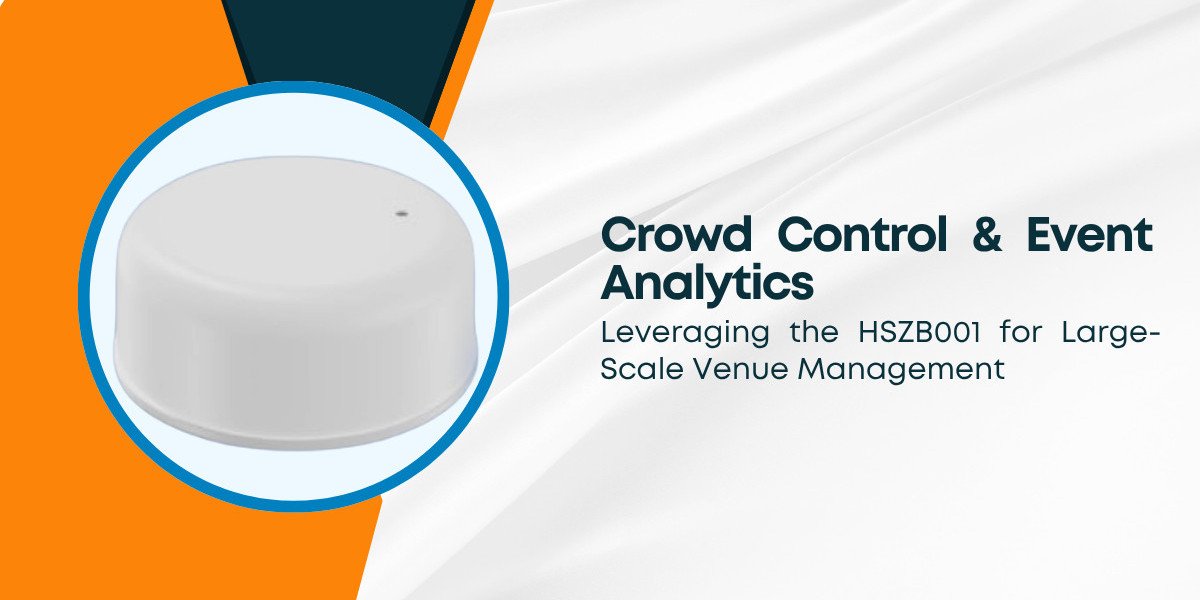
Modern venue managers solve this challenge by deploying Bluetooth Low Energy infrastructure. The core hardware component driving this technological shift is the HSZB001 Ultra-Long Range Beacon. This industrial-grade tracking device transmits continuous signals over massive distances. It gives venue management software the precise data needed to monitor crowd behaviors, optimize staff deployment, and safeguard public safety.
The Technical Challenges of Large-Scale Venue Logistics
Large-scale public venues include football stadiums, massive convention halls, music festival grounds, and international airport terminals. These spaces share common operational hazards that scale up as crowd sizes expand.
1. Signal Attenuation in High-Density Crowds
Human bodies consist mostly of water, which absorbs radio frequencies operating at 2.4 GHz. This is the exact frequency band utilized by standard Bluetooth, Wi-Fi, and Zigbee devices.
When thirty thousand people pack into a tight concert arena, they create a massive wall of radio signal interference. Standard commercial beacons lose half of their broadcast distance in these environments. Their short signal bursts cannot penetrate dense crowds, resulting in data gaps for the analytical tracking software.
2. The Limits of Wide Physical Spaces
Convention centers often feature open exhibition floors spanning over 100,000 square meters. Deploying short-range commercial beacons across these immense physical spaces creates a maintenance disaster.
Technicians must mount thousands of small devices to high ceilings and concrete pillars to maintain signal coverage. Each individual device requires independent tracking, calibration, and battery replacements. This high volume of hardware drives up installation costs and introduces too many points of failure into the security infrastructure.
Technical Specifications of the HSZB001
The HSZB001 Ultra-Long Range Beacon uses specific hardware architecture designed to bypass the physical limitations of standard Bluetooth transmitters.
1. RF Architecture and Processing Power
The device relies on premium Nordic Semiconductor chipsets, featuring options for the nRF52833 or nRF52840 processors. These chips execute advanced hardware-based cryptographic algorithms while drawing minimal electric current.
The integrated radio frequency power amplifiers can boost transmission settings up to +8 dBm. This allows the beacon to slice through dense physical obstacles and human crowds with minimal packet loss.
2. Long-Distance Capabilities and Power Profiles
The defining performance trait of this device is its long-range radio broadcast capability. It achieves an open-field broadcasting range of up to 1,968 feet or 600 meters.
Performance Metric | Standard Commercial Beacon | HSZB001 Ultra-Long Range Beacon |
Maximum Broadcast Range | 30 to 50 meters | Up to 600 meters (1,968 feet) |
Core Battery Service Life | 1 to 2 years | Up to 10 years continuous |
Environmental Protection | IP54 Splash Resistant | IP67 Waterproof and Dustproof |
Supported Protocols | iBeacon only | iBeacon and Eddystone Simultaneous |
Operational Temperature | 0°C to 40°C | -20°C to 65°C |
The Ultra-Long Range Beacon maintains this immense coverage range while extending its physical hardware service life. A specialized internal lithium battery pack keeps the device powered for up to 10 years. This long lifespan minimizes maintenance requirements, making it ideal for permanent installations in hard-to-reach stadium rafters.
Transforming Crowd Control with Ultra-Long Range Beacons
Deploying an Ultra-Long Range Beacon network transforms how security teams handle crowd density fluctuations during high-profile public events.
1. Real-Time Ingress and Egress Monitoring
The initial entry phase of an event creates intense pressure on stadium security gates. The HSZB001 transmits continuous location telemetry that pairs with visitor smartphones via a dedicated venue mobile application.
As guests walk through outer parking complexes toward ticket booths, the system tracks their movement speed. If the arrival rate exceeds gate processing capacity, the management software triggers an early warning. Security teams can then divert arriving crowds to shorter lines before dangerous bottlenecks form.
2. Mitigating Chokepoint Risks
Specific areas within large venues present permanent architectural risks. Concourse intersections, restroom corridors, and escalator exits prone to dangerous crush incidents require constant monitoring.
The wide coverage area of the HSZB001 lets operators set up large virtual geofences over these zones. The analytical engine calculates the exact dwell times of users within these geofences. If the average dwell time rises by 40% over a five-minute window, the system automatically flags a potential crowd crush hazard.
Precision Data Collection and Event Analytics
Beyond physical crowd safety, long-range beacon networks capture high-fidelity spatial data. This information helps venue owners optimize spatial layouts and maximize food, beverage, and merchandise revenue.
1. Heatmapping and Spatial Utilization
The simultaneous transmission of iBeacon and Eddystone protocols allows the HSZB001 to pass data across varying mobile operating systems. The venue system gathers anonymized Received Signal Strength Indicator data points from active devices.
The software compiles these data inputs to generate live thermal heatmaps of the entire facility. Managers can pinpoint exactly which exhibition booths attract the highest foot traffic. They can also identify underutilized dead zones on the venue floor, adjusting future leasing prices based on proven spatial performance metrics.
2. Measuring Attendee Engagement Profiles
Conventional ticket tracking tells operators when a guest arrives and leaves the outer gates. It reveals nothing about how that guest behaves inside the venue.
Ultra-long range tracking networks solve this visibility issue by recording customer movement timelines. The system tracks the exact duration an individual spends browsing a merchandise stand or waiting at a food stall. These data profiles help vendors adjust their staffing schedules to match historical demand peaks throughout an event.
Implementing the HSZB001 in Large Venue Environments
Deploying a successful location-aware network requires careful physical placement and accurate software configuration.
1. Network Topology and Gateway Placement
Because the HSZB001 features a broad 600-meter broadcast radius, venues require fewer physical receiver installations. Operators install fixed Bluetooth-to-Wi-Fi gateways at central structural intersections.
The beacons are mounted throughout the open seating bowls and concourses using screw brackets or industrial adhesive tapes. The gateways pick up the beacon signals from consumer phones, sending the data to local edge servers via secure MQTT protocols.
2. Software Configuration via BeaconSET+
Engineering teams calibrate the tracking network using the BeaconSET+ mobile application. Technicians configure the unique identifier values for each unit without needing physical cable attachments.
They can adjust the radio transmission power from -20 dBm up to +8 dBm to match local architectural conditions. Technicians can also modify the advertising frequency interval between 100 milliseconds and 5000 milliseconds. This optimizes data accuracy and battery longevity for specific areas of the venue.
Architectural Case Studies
Real-world deployments demonstrate the practical capabilities of these long-range hardware systems.
1. International Exhibition Center Deployment
A major exhibition complex faced severe crowd coordination issues during its annual four-day technology convention. The facility featured four interconnecting halls covering 80,000 square meters.
The operational team deployed 120 HSZB001 beacons across the high ceiling trusses. The long-range signals bypassed the metallic interference caused by large exhibition booths. The system gave operators real-time occupancy counts for each hall. During a peak attendance spike on day two, the system detected a crowd surge in Hall 3. Security personnel rerouted incoming attendees to secondary entrances, preventing an over-capacity emergency.
2. Professional Sports Stadium Optimization
A 50,000-seat outdoor football stadium deployed ultra-long range beacons to optimize concession sales and reduce halftime concourse congestion. The IP67 rugged housing protected the hardware from rain, dust, and pressure washing cycles.
The collected analytics data revealed that fans on the upper deck faced 15-minute wait times for food stalls. In response, management added mobile beverage carts to underutilized concourse areas highlighted by the tracking software. This operational change decreased average wait times to under seven minutes and boosted concession revenues by 22% over the season.
The Strategic Return on Infrastructure Investment
Upgrading to an advanced industrial tracking network requires an upfront capital investment. However, the long-term operational savings outweigh these initial procurement costs.
1. Lower Hardware Maintenance Expenditures
Standard beacons require battery changes every eighteen months. In a large venue with hundreds of devices, battery maintenance creates continuous labor costs.
The 10-year battery system of the HSZB001 slashes these recurring maintenance cycles. Venue staff deploy the hardware once and leave it running for a decade. This reliability reduces labor costs and keeps technicians focused on core facilities maintenance.
2. Enhancing Commercial Sponsorship Value
Modern event sponsors demand clear metrics to justify their marketing investments. Instead of relying on vague attendance estimates, venue operators can provide verified engagement statistics.
Operators can show corporate sponsors exactly how many unique visitors walked past an advertising banner. They can also report the exact average dwell time near specific product displays. This precise data lets venues charge premium rates for high-visibility spots, driving new revenue options.
Future Technological Integrations
Location tracking hardware continues to evolve, paving the way for deeper integration with broader smart venue management ecosystems.
1. Combining Tracking Data with AI Video Feeds
Modern venue operating systems combine Bluetooth beacon location tracking with artificial intelligence video analytics. While cameras provide overall crowd counts, the beacon network tracks individual movement paths through the venue.
Combining these two data streams gives operators complete situational awareness. The system can instantly spot when a single person enters a restricted zone or when a crowd forms in front of an emergency exit.
2. Transitioning to Zero-Trust Venue Security
Future software configurations will move toward zero-trust security frameworks. In this model, the venue network continuously verifies the identity of every connected device.
The HSZB001 supports this transition by transmitting encrypted data packets that change keys automatically. This security layer prevents bad actors from cloning beacon IDs or injecting fake location data into the crowd management platform.
Conclusion
Successfully managing large-scale public venues requires advanced data collection tools that can withstand challenging physical environments. The HSZB001 Ultra-Long Range Beacon delivers the durability, broadcast range, and battery life needed to monitor high-density crowds reliably.
By replacing short-range commercial hardware with an industrial-grade Ultra-Long Range Beacon network, venue managers get the real-time insights required to protect public safety. This technology helps operators avoid dangerous crowd crush incidents, optimize floor layouts, and grow vendor revenues, making it an essential tool for modern venue management.