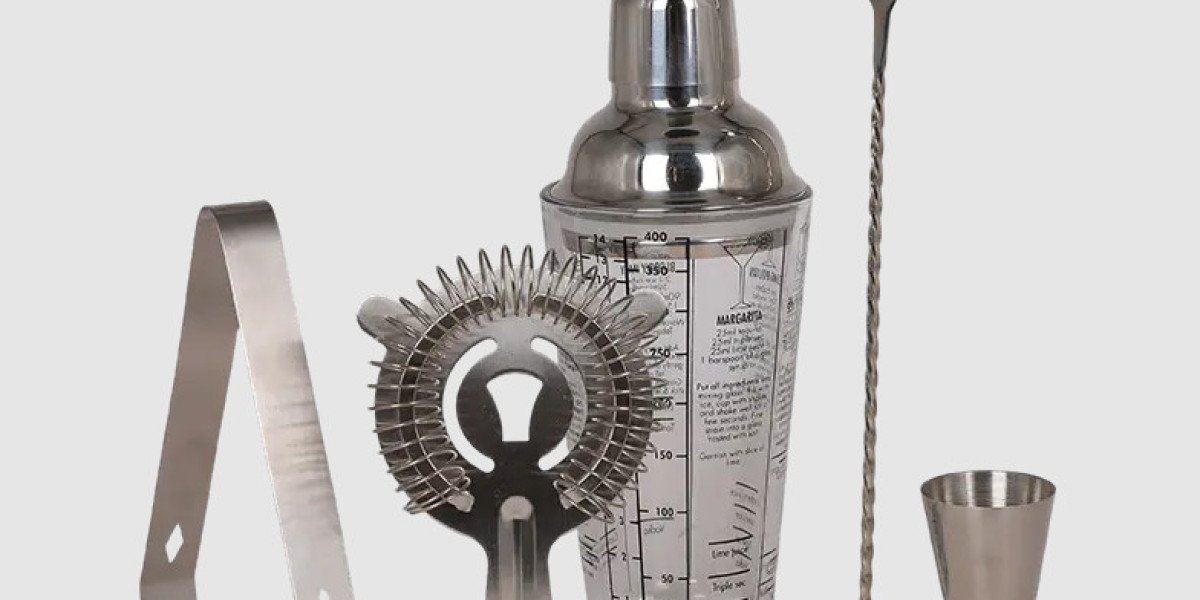

The barware industry has shifted noticeably in recent years, driven by changes in home entertainment habits and global supply chain adjustments. A barware kit is no longer treated as a simple toolset but as a configurable product system. Within this trend, the stainless steel bartender kit has become a flexible foundation for OEM customization.
One major trend is modular design. Instead of fixed combinations, manufacturers now develop interchangeable components. This means a shaker set can be paired with different types of strainers or jiggers depending on customer requirements. Modular systems help distributors target different price segments without redesigning the entire product line. It also simplifies inventory management, as shared components can be used across multiple SKUs.
OEM customization has expanded beyond logo printing. Buyers increasingly request structural modifications, such as adjusting shaker capacity from 500 ml to 700 ml, or changing jigger volume scales between metric and imperial systems. These adjustments are relatively easy to implement when using stainless steel due to its predictable forming properties. Laser engraving has also become more common for branding, replacing older printing methods that may fade over time.
Consumer behavior is another factor influencing design direction. Social media platforms have increased interest in visually appealing drink preparation. As a result, a barware kit is often evaluated not only by functionality but also by presentation. This has led to increased demand for matte black coatings, gold-plated finishes, and mixed-material combinations. Even within a stainless steel bartender kit, surface finishing variations can significantly change perceived value.
Sustainability is gradually influencing procurement decisions. Reusable stainless steel tools reduce dependency on disposable plastic accessories. Some manufacturers are also optimizing production waste by recycling off-cuts from stamping processes. While this does not eliminate environmental impact, it contributes to more efficient material utilization.
Another emerging trend is compact design for urban living spaces. As apartment sizes decrease in many cities, storage efficiency becomes a priority. Barware kits are being redesigned to fit into smaller kitchen drawers or wall-mounted racks. Stackable shakers and collapsible measuring tools are examples of this adaptation.
From a supply chain perspective, flexibility is increasingly important. OEM clients often require fast adjustments in packaging, branding, and tool combinations. Stainless steel as a base material supports this flexibility because it is compatible with multiple finishing techniques and does not require major structural redesign when adapting to new market demands.
Digital purchasing channels have also influenced product development. Online retailers tend to favor kits that are visually complete and easy to understand from images alone. This has encouraged manufacturers to standardize component layouts, ensuring that each stainless steel bartender kit communicates clear value even before use.