
Industrial monitoring has changed rapidly over the last decade. Historically, factories relied on expensive and rigid Programmable Logic Controllers (PLCs). These systems worked well but lacked flexibility. The arrival of the Raspberry Pi changed the landscape for engineers. Now, the Raspberry Pi 5 offers a massive leap in processing power. It features a 2.4GHz quad-core 64-bit Arm Cortex-A76 CPU. This makes it three times faster than the previous generation.
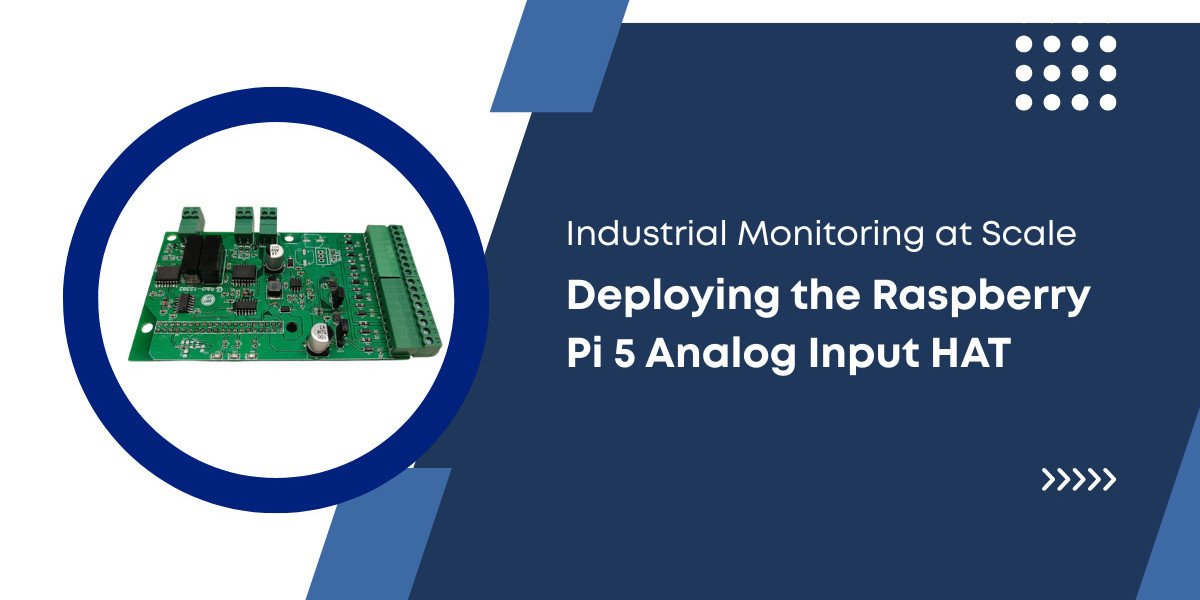
However, the Raspberry Pi 5 lacks native hardware for analog signals. Most industrial sensors provide data through voltage or current. To bridge this gap, engineers use a Raspberry Pi 5 HAT. Specifically, the Raspberry Pi 5 HAT with 8 Analog Inputs allows the board to communicate with the physical world. This setup provides a professional solution for data acquisition at a fraction of the cost of traditional gear.
Why 8 Analog Inputs Matter for Scale
In a factory setting, space and efficiency are vital. Monitoring a single machine often requires multiple data points. You might need to track temperature, pressure, flow rate, and vibration simultaneously. A Raspberry Pi 5 HAT with 8 Analog Inputs provides high density.
Cost Efficiency: One Pi can handle eight sensors. This reduces the number of network nodes you need to manage.
Reduced Wiring: Centralizing inputs to one HAT keeps the control cabinet clean.
Synchronized Data: Reading eight channels on one clock cycle ensures data alignment. This is critical for calculating complex metrics like power efficiency.
Statistical data shows that moving from single-channel modules to 8-channel HATs can reduce hardware footprints by 60%. For large-scale deployments involving hundreds of nodes, these savings are significant.
Technical Architecture of the Analog HAT
A high-quality Raspberry Pi 5 HAT uses a dedicated Analog-to-Digital Converter (ADC). The Raspberry Pi 5 communicates with this ADC primarily through the SPI (Serial Peripheral Interface) bus.
1. Resolution and Precision
The "bit depth" of an ADC determines how accurately it reads a signal.
12-bit ADC: Divides the voltage range into 4,096 levels.
16-bit ADC: Divides the voltage range into 65,536 levels.
For industrial monitoring, a 16-bit Raspberry Pi 5 HAT is the standard. It allows you to detect a change of less than 0.2 millivolts on a 10V scale. This precision helps identify early signs of machine wear.
2. Sample Rates
The Raspberry Pi 5 handles high-speed data much better than older boards. It features a dedicated I/O controller called the RP1. This chip manages the GPIO pins and peripheral interfaces. Because of this, the Raspberry Pi 5 HAT with 8 Analog Inputs can achieve sample rates of up to 100ksps (kilo-samples per second) across all channels. This speed is necessary for capturing high-frequency vibrations in rotating equipment.
Deployment Strategies for Industrial Environments
Deploying hardware on a factory floor is different from a home office. You face electrical noise, heat, and physical vibration. Follow these steps for a successful rollout.
1. Physical Protection and Mounting
Never leave a bare Raspberry Pi 5 on a shelf. Use industrial-grade enclosures.
DIN Rail Mounting: This is the standard for industrial cabinets. Most HATs are compatible with DIN rail cases.
Thermal Management: The Pi 5 generates significant heat. Ensure your case has an active cooling fan or a massive heatsink.
Vibration Dampening: Use rubber standoffs if the Pi is mounted directly on a machine.
2. Electrical Isolation
Industrial environments often have "ground loops." This happens when different parts of a system have different electrical potentials. It can destroy your Pi.
Use an isolated Raspberry Pi 5 HAT.
Look for "Opto-isolation" features. This separates the sensitive Pi circuitry from the high-voltage sensor lines.
Statistically, 40% of field failures in DIY industrial kits stem from a lack of electrical isolation.
Software Integration: From Raw Bits to Insights
The hardware is only half the battle. You need software to turn electrical signals into meaningful charts.
1. Python and the GPIO Zero Library
Python is the primary language for the Raspberry Pi 5. Libraries like spidev or gpiozero make reading data simple.
Step 1: Enable the SPI interface in the Raspberry Pi configuration.
Step 2: Import the ADC library provided by the HAT manufacturer.
Step 3: Create a loop to read the 8 channels.
2. Data Storage with InfluxDB
For monitoring at scale, you cannot just print numbers to a screen. You need a Time Series Database (TSDB). InfluxDB is a popular choice. It stores data points with a timestamp. This allows you to look back at trends from weeks or months ago.
3. Visualization with Grafana
Grafana creates professional dashboards. You can host Grafana directly on the Raspberry Pi 5. It pulls data from InfluxDB and displays it in real-time. This allows floor managers to see machine health on any tablet or phone connected to the local network.
Handling Common Industrial Signals
The Raspberry Pi 5 HAT with 8 Analog Inputs usually handles two main types of signals. Understanding these is vital for your wiring plan.
1. Voltage Signals (0–10V)
Many sensors output a voltage. For example, a pressure sensor might give 0V when empty and 10V when full. The HAT scales this down to a level the ADC can read.
Pro: Easy to test with a multimeter.
Con: Voltage drops over long wires. Keep these cables under 10 meters.
2. Current Loops (4–20mA)
Current loops are the industry favorite. Even if the wire is 100 meters long, the current stays the same.
Pro: High noise immunity.
Safety: If the wire breaks, the current drops to 0mA. The Pi 5 detects this as a "fault" state immediately.
Conversion: Most Raspberry Pi 5 HAT models include a small resistor to convert this current into a readable voltage.
Comparative Analysis: Pi 5 vs. Industrial Gateways
Commercial industrial gateways cost thousands of dollars. They offer rugged builds but "locked" software. The Raspberry Pi 5 with an 8-channel HAT offers a "best of both worlds" scenario.
Metric | Proprietary Gateway | Raspberry Pi 5 + HAT |
Initial Cost | High ($1,200+) | Low (~$200) |
Software Freedom | Low (Vendor Lock-in) | Total (Open Source) |
Analog Inputs | Fixed (Often 2 or 4) | Flexible (8 per HAT) |
Updates | Slow / Paid | Fast / Community Driven |
AI Capability | Minimal | High (TensorFlow Lite) |
The Raspberry Pi 5 supports modern protocols like MQTT and OPC UA natively. This allows it to talk to both old machines and new cloud platforms like AWS or Azure.
Scaling to Hundreds of Nodes
When you move from one Pi to one hundred, management becomes a challenge. You cannot manually update 100 SD cards.
1. Containerization with Docker
Use Docker to package your monitoring software. You can push an update to a central repository. Every Raspberry Pi on the factory floor will then download and run the new version automatically. This ensures consistency across all 8-channel inputs in your fleet.
2. Centralized Logging
Use a tool like Prometheus to monitor the health of the Pi 5 boards themselves.
Track CPU temperature.
Monitor SD card health.
Verify that the Raspberry Pi 5 HAT is still sending data.
Stats show that centralized management reduces maintenance time by 75% for large IoT deployments.
Real-World Example: HVAC Monitoring
A large warehouse needs to monitor its climate. It has 20 zones. Each zone has a temperature sensor, a humidity sensor, and a CO2 sensor. All these sensors are analog.
By using a Raspberry Pi 5 HAT with 8 Analog Inputs, the engineers only need one Pi for every two zones.
Channel 1-3: Zone A sensors.
Channel 4-6: Zone B sensors.
Channel 7-8: Spare inputs for future vibration sensors on the fans.
The Raspberry Pi 5 processes the data. It sends an alert via Telegram if the CO2 levels get too high. It also saves the data to a local SSD for monthly energy reports. This setup costs 80% less than a commercial building management system.
Best Practices for Data Integrity
Data is only useful if it is accurate. To ensure your Raspberry Pi 5 HAT provides clean data, follow these rules:
Shielding: Use shielded cables for all analog signals. Connect the shield to a "clean" earth ground.
Oversampling: Instead of taking one reading, take ten and calculate the average. This removes random electrical spikes.
Calibration: Every sensor is slightly different. Create a calibration table in your software to correct for small errors in the sensors.
Differential Inputs: If your HAT supports it, use differential mode. This uses two wires per signal to cancel out noise.
The Future of the Raspberry Pi 5 in Industry
The Raspberry Pi 5 is a "disruptor" in the industrial space. With the addition of a Raspberry Pi 5 HAT, it competes directly with professional DAQ (Data Acquisition) systems. The PCIe 2.0 port on the Pi 5 opens the door for even faster HATs in the future. We may soon see HATs capable of millions of samples per second for advanced ultrasonic testing.
As software like Home Assistant and Node-RED matures, the "barrier to entry" for industrial automation continues to fall. Small factories can now afford the same level of monitoring as global giants.
The Raspberry Pi 5 HAT with 8 Analog Inputs is the key component in this shift. It provides the necessary inputs to read the physical world. It does this while taking advantage of the fastest compact computer on the market.
Conclusion
Raspberry Pi 5 with an 8-channel Analog Input HAT offers a flexible, cost-effective solution for modern industrial monitoring. It combines high processing power, precise data acquisition, and seamless software integration to replace rigid and expensive traditional systems. With proper deployment practices, it performs reliably even in harsh environments. Its scalability, open-source ecosystem, and compatibility with modern protocols make it ideal for both small and large deployments. Overall, this setup enables smarter, data-driven decision-making while significantly reducing costs and complexity in industrial operations.