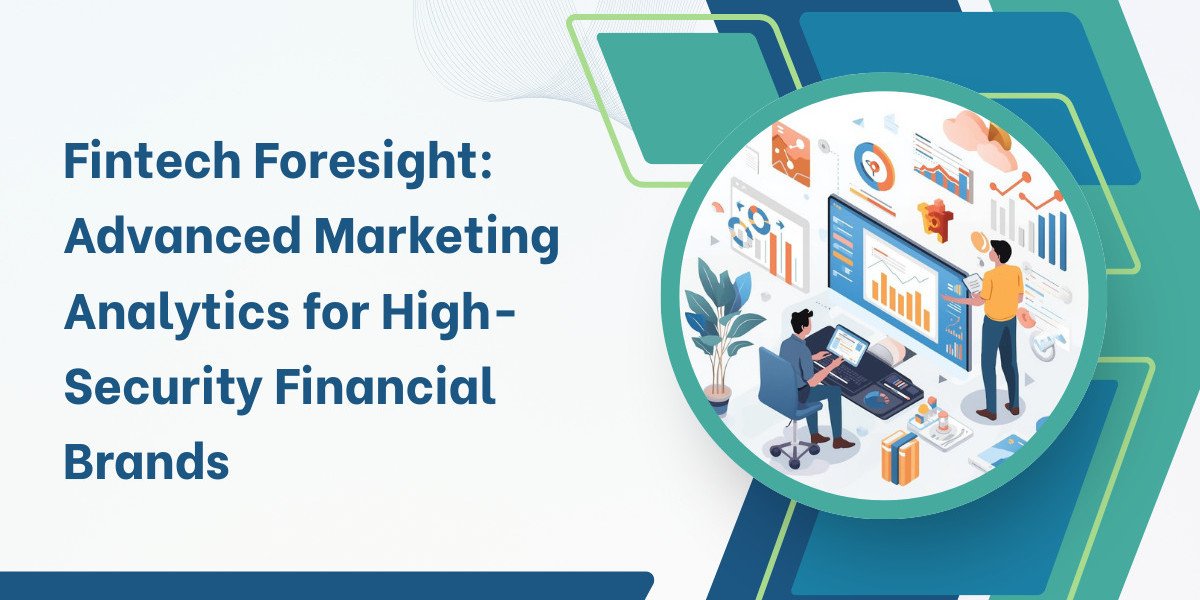

The financial sector faces a massive transformation in 2026. The global market for business analytics in fintech currently sits at $5.3 billion. Experts expect this figure to soar to $40 billion by 2035. For high-security financial brands, the stakes are even higher. These institutions must balance aggressive growth with ironclad data protection.
The Evolution of Marketing Intelligence in Finance
Marketing in finance has moved beyond simple demographics. In the past, a bank might target "people aged 30 to 50." Today, that is not enough. High-security brands now use behavioral and transactional intelligence.
1. Moving Beyond the Cookie
The "death of the third-party cookie" forced a shift to first-party data. Financial brands possess a goldmine of this data. They know how users spend, save, and invest. Advanced analytics allow brands to use this information safely. By 2026, 75% of financial firms will use AI to process these internal signals.
2. Real-Time Decision Engines
Financial markets move in milliseconds. Marketing must do the same. If a user receives a large inheritance, the bank should offer investment advice immediately. Marketing Data Analytics enables "Next-Best-Action" logic. This system analyzes real-time events and suggests the perfect product for that specific moment.
Privacy-Enhancing Technologies (PETs)
High-security brands use specialized tools called Privacy-Enhancing Technologies. These allow for deep analysis without touching raw personal data. This is the "Technical Foresight" that separates winners from losers.
Differential Privacy: This adds mathematical "noise" to a dataset. Analysts can see overall trends but cannot identify a single individual. The U.S. Census Bureau uses this method to protect citizen privacy.
Homomorphic Encryption: This allows computers to perform calculations on encrypted data. The system never "sees" the actual numbers, but it still produces the correct result.
Federated Learning: Instead of moving data to a central server, the AI model travels to the user's device. The model learns from the local data and sends back only the "lessons" it learned.
These technologies ensure that Marketing Data Analytics Services comply with strict laws like GDPR and the EU AI Act. Using PETs can reduce data breach risks by up to 60%.
Leveraging Agentic AI for Marketing
In 2026, we are seeing the rise of "Agentic AI." These are autonomous systems that do more than just generate text. They can complete entire workflows.
1. Autonomous Campaign Optimization
An AI agent can manage a million-dollar ad budget. It tests thousands of variations of an ad in seconds. It shifts money away from failing ads and toward successful ones. This happens 24/7 without human intervention. Statistics show that AI-driven personalization can increase leads by five times.
2. Generative Engine Optimization (GEO)
Traditional SEO is changing. People now ask AI models for financial advice. A high-security brand must ensure these AI models "recommend" its products. This requires structuring data so machines can read it easily. Brands that master GEO see a significant boost in organic visibility within AI-generated answers.
The Architecture of High-Security Analytics
Building a secure marketing stack requires a modular, cloud-native architecture. Monolithic systems are too slow and too vulnerable.
1. Data Mesh Integration
Many top firms use a "Data Mesh." This decentralizes data ownership. The marketing team owns "marketing data products," while the risk team owns "compliance data products." This prevents a single point of failure. If one part of the system is breached, the rest remains safe.
2. Confidential Computing
High-security brands often use "Confidential Computing." This processes data in a secure enclave within the computer's hardware. Even the cloud provider cannot see the data being processed. This is essential when handling high-net-worth individual (HNWI) data. 72% of HNWIs prefer firms that offer this level of highly personalized and secure service.
Comparison of Analytics Approaches
Feature | Traditional Analytics | Advanced Fintech Analytics |
Data Source | Third-party cookies | First-party transactional data |
Processing | Manual/Batch | Real-time / Agentic AI |
Privacy | Basic encryption | PETs (Differential Privacy, FHE) |
Compliance | Afterthought | Integrated into the workflow |
Outcome | Static reports | Dynamic, automated actions |
Case Study: Scaling a Wealth Management Brand
A European wealth management firm wanted to increase its client base among "affluent millennials." They could not use standard social media tracking due to strict privacy rules. They partnered with Marketing Data Analytics Services to build a secure "Data Clean Room."
The firm uploaded its encrypted client data into a neutral, secure zone. They matched this against a publisher's audience data. The system identified common behaviors among their most profitable clients without ever revealing their names. The firm used these insights to launch a hyper-personalized campaign.
Result: They achieved a 300% increase in qualified leads.
Security: Not a single piece of Personally Identifiable Information (PII) left the firm’s servers.
Managing Risk and Compliance
In a high-security environment, every marketing campaign must pass through a compliance filter. Advanced analytics can automate this.
Automated Audit Trails: The system records every data touchpoint. If a regulator asks why a certain ad was shown, the firm can provide a mathematical proof.
Bias Detection: AI models can unintentionally become biased. Advanced Marketing Data Analytics includes "Explainability" modules. These explain how a model made a decision, ensuring it does not discriminate against certain groups.
Real-Time Governance: In 2026, manual spreadsheets are obsolete. Firms use real-time dashboards to monitor compliance across all global markets.
The Future of Machine-to-Machine Marketing
By late 2026, roughly 20% of customer interactions will involve AI agents acting on behalf of humans. A user's personal AI "agent" might shop for the best savings account.
High-security brands must market to these machines. This means providing clear, verified, and authoritative data that a machine-customer can trust. Marketing Data Analytics helps brands understand how these AI agents behave. This is the next frontier of growth for the fintech sector.
Summary of Best Practices
Focus on First-Party Data: Your own customer data is your most valuable asset.
Adopt PETs Early: Use differential privacy and federated learning to stay ahead of regulations.
Invest in GEO: Ensure your brand is the "top choice" for AI-powered search engines.
Automate Compliance: Move away from manual checks to real-time, auditable systems.
Conclusion
Advanced Marketing Data Analytics is the engine of the 2026 fintech economy. For high-security brands, it is no longer enough to just be "safe." You must be intelligent. The shift toward decentralized data, agentic AI, and privacy-enhancing technologies allows brands to grow without compromise.
By leveraging professional Marketing Data Analytics Services, financial institutions can build deep, lasting relationships with their clients. As regulations tighten and competition grows, the ability to turn secure data into personalized foresight will define the industry leaders. The future of finance belongs to those who can protect their customers while predicting their needs.