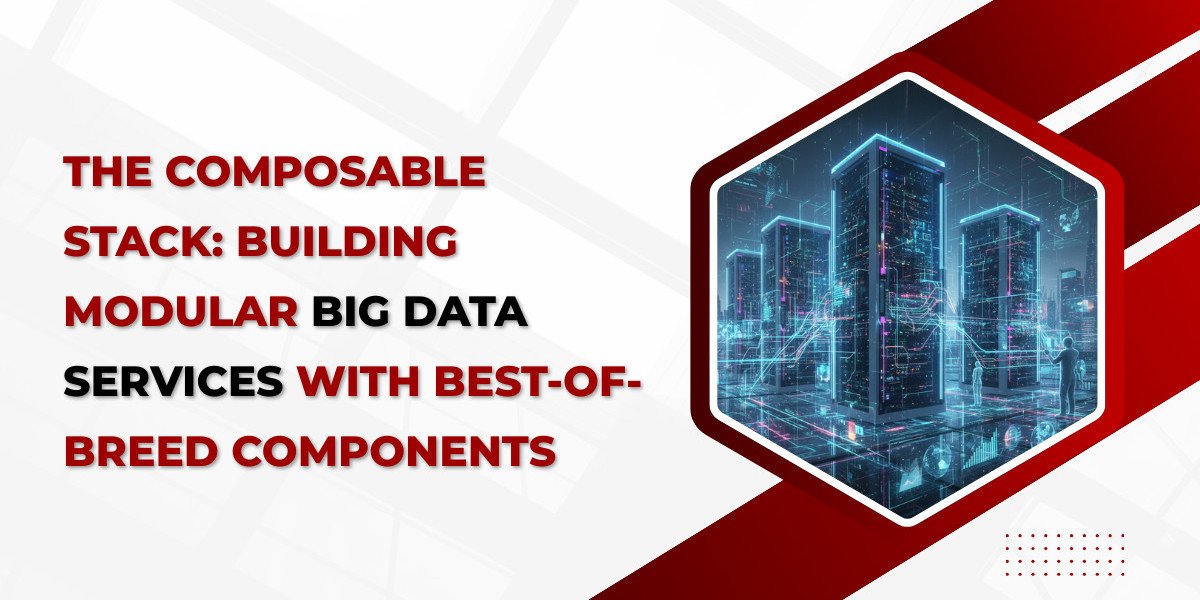

In 2026, the era of "all-in-one" monolithic data platforms is fading. Modern enterprises no longer want to be trapped in expensive, inflexible ecosystems. Instead, they are moving toward The Composable Stack. This architectural shift allows organizations to assemble their Big Data Analytics Services using modular, best-of-breed components that talk to each other via open APIs.
By 2026, the global market for composable infrastructure has surpassed $14 billion, growing at a staggering 32% CAGR. This growth reflects a fundamental truth: modularity provides the agility required to survive in an AI-driven economy.
The Death of the Monolith
For decades, businesses bought "full-suite" solutions. These platforms promised to handle everything from ingestion to visualization. However, they often created significant technical debt.
Vendor Lock-in: Moving data out of a monolithic system is often costly and complex.
Slow Innovation: You must wait for the vendor to release new features.
Scaling Inefficiency: You cannot scale just the "compute" or "storage" independently; you must pay for the whole package.
The composable stack solves these problems by decoupling every layer of the data lifecycle.
Layer 1: Modular Data Ingestion and ELT
In a composable architecture, ingestion is the first independent module. Instead of a single tool, organizations use specialized "Extract, Load, Transform" (ELT) services.
The Shift from ETL to ELT
In 2026, 90% of high-performance teams prefer ELT over traditional ETL. In ELT, raw data lands in the warehouse immediately. Transformations happen later, using the massive parallel processing power of the cloud.
Batch Ingestion: Tools like Fivetran or Airbyte connect to SaaS apps (Salesforce, Zendesk) and move data on a schedule.
Streaming Ingestion: For real-time needs, services like Apache Kafka or Confluent ingest millions of events per second with sub-second latency.
This modularity allows you to swap an ingestion tool without affecting your analytics or storage layers.
Layer 2: The Storage and Compute Engine
The heart of the composable stack is a high-performance, cloud-native storage layer. Most enterprises now choose a Data Lakehouse architecture. This combines the cheap storage of a data lake with the high-performance query capabilities of a warehouse.
Leading Engines in 2026
Technology | Primary Strength | Ideal Use Case |
Snowflake | Zero-management, multi-cloud | Enterprise BI and data sharing |
Databricks | Unified AI and analytics | Machine learning and data science |
Google BigQuery | Serverless, built-in ML | Large-scale ad-tech and log analysis |
Because these engines are composable, they support "zero-copy" data sharing. This means different tools can analyze the same data without moving it, reducing costs and security risks.
Layer 3: The Transformation and Semantic Layer
Raw data is rarely ready for a CEO's dashboard. It needs cleaning and modeling. In a modular stack, this is handled by a dedicated transformation layer—most commonly using dbt (data build tool).
The Rise of the Universal Semantic Layer
In 2026, a new component has emerged: the Semantic Layer. Traditionally, business logic (like "How do we calculate Gross Margin?") was buried inside a BI tool. If you switched BI tools, you lost that logic.
The Composable Solution: Tools like Cube or dbt Semantic Layer define metrics outside the visualization tool.
The Result: Whether you use Tableau, Power BI, or a custom AI agent, everyone sees the exact same number. This creates a "single source of truth" that remains stable even if you swap other parts of the stack.
Layer 4: Intelligence and Data Activation
The final layer is where Big Data Analytics Services deliver value. In 2026, this has expanded beyond simple charts.
1. Conversational AI and Agentic Analytics
Static dashboards are no longer enough. Composable stacks now include an Agentic Layer. These are AI agents that can "read" your semantic layer and answer complex questions in natural language.
Example: "Why did our churn rate increase in the Northeast region last Tuesday?"
Technical Flow: The agent generates a SQL query, runs it against the Lakehouse, and provides a summarized answer with a chart.
2. Reverse ETL (Data Activation)
Insights are useless if they stay in the warehouse. Reverse ETL tools like Hightouch or Census push analyzed data back into operational tools.
Marketing: Pushing a "High-Risk Churn" segment from the data lake directly into an email tool (like Braze) to trigger a discount offer.
Sales: Syncing a "Product Qualified Lead" score into Salesforce so reps know who to call first.
Technical Best Practices for Building Modularly
Building a composable stack requires discipline. Without a clear plan, you risk "tool sprawl," where you have too many disconnected services.
1. Prioritize Data Observability
With many moving parts, you need a way to monitor the health of your pipelines. Data observability tools (like Monte Carlo) act as a "smoke detector." They alert you if a table stops updating or if the data volume looks suspicious.
Stat: Companies using data observability reduced their pipeline downtime by 45% in 2025.
2. Implement Data Governance and Lineage
You must know where every piece of data came from. Composable stacks use Data Catalogs (like Alation or Atlan) to provide a map of the entire ecosystem. This is critical for meeting 2026 compliance standards like the EU AI Act or HIPAA.
3. Focus on Developer Experience (DataOps)
Treat your data code like software.
Use Git for version control of your SQL models.
Use CI/CD pipelines to test data quality before it reaches production.
Use Orchestration tools (like Airflow or Dagster) to manage the timing and dependencies between different modules.
The ROI of the Composable Approach
The financial argument for the composable stack is clear. While the initial setup might require more engineering time, the long-term savings are significant.
Cost Efficiency: You only pay for what you use. If you need more storage but not more compute, you only scale the storage.
Talent Retention: Skilled data engineers prefer working with modern, open tools rather than legacy, proprietary systems.
Agility: A modular stack allows you to integrate new AI technologies in weeks, not months. In 2026, this speed is a primary competitive advantage.
Conclusion
The move toward The Composable Stack is a declaration of independence for data teams. By breaking down the monolith and building with modular, best-of-breed components, organizations ensure their Big Data Analytics remain fast, fair, and future-proof. In 2026, the businesses that win are not those with the most data, but those with the most adaptable data infrastructure.
Investing in Big Data Analytics Services that embrace this modular philosophy allows you to build a system that evolves alongside your business. Whether you are adding a new AI agent or switching to a faster storage engine, the composable stack ensures that your data remains your most valuable, and most flexible, asset.