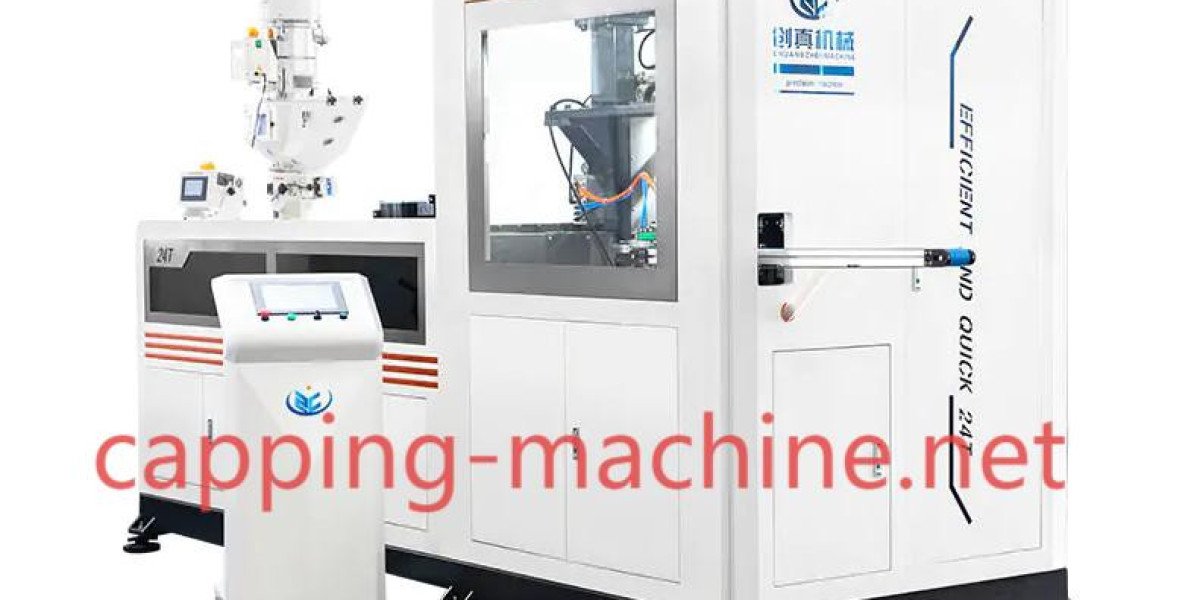

In today’s packaging industry, evolving consumer expectations and brand differentiation strategies have reshaped how plastic closures are produced, and the Cap Compression Machine has become an important response to these changes by aligning efficiency, consistency, and adaptability within a single manufacturing solution. As packaging volumes increase and product varieties diversify, manufacturers are under pressure to deliver uniform caps while controlling operational costs and maintaining stable output quality.
Market demand is no longer defined solely by production speed. Beverage, food, pharmaceutical, and household chemical sectors all require closures that meet precise functional standards, such as torque stability, sealing integrity, and material efficiency. This shift has driven manufacturers to adopt compression-based forming technologies that reduce material waste and enhance dimensional consistency. Compared with traditional injection methods, compression forming supports high-volume production while enabling manufacturers to respond more quickly to changing cap designs and regional packaging regulations.
Technological innovation has played a central role in improving energy efficiency within modern cap production equipment. Mechanical structures have been refined to minimize unnecessary motion, while optimized heating and compression cycles allow materials to reach forming conditions with lower overall energy input. In response to rising electricity costs and sustainability targets, machinery designers increasingly focus on reducing idle power consumption and improving thermal efficiency without sacrificing throughput.
Automation systems further strengthen this efficiency advantage. Advanced control platforms enable real-time monitoring of pressure, temperature, and cycle timing, allowing operators to maintain stable production conditions even during extended operating hours. This level of control reduces the risk of deformation or surface defects, contributing to a higher percentage of usable output. For manufacturers aiming to scale production while keeping labor costs manageable, automated compression forming equipment offers a practical balance between performance and operational simplicity.
Application scenarios for compression-based cap manufacturing continue to expand. Beverage packaging remains a core market, particularly for water, carbonated drinks, and functional beverages that require lightweight yet reliable closures. At the same time, the personal care and household chemical industries benefit from compression-formed caps due to their smooth surface finish and consistent thread accuracy, which support both aesthetic appeal and functional reliability.
In pharmaceutical and healthcare-related packaging, production stability and repeatability are critical. Compression forming technology enables manufacturers to maintain uniform wall thickness and dimensional precision across large batches, supporting downstream filling and sealing processes. This consistency reduces compatibility issues during automated capping operations and enhances overall packaging line efficiency.
Performance advantages are not limited to output quality alone. Material utilization efficiency is another key factor driving adoption. By optimizing resin distribution during the compression process, manufacturers can achieve required strength and sealing performance with reduced material usage. Over time, these material savings contribute to lower per-unit production costs and improved sustainability metrics, aligning with environmental responsibility goals increasingly emphasized by global brands.
Durability and equipment lifespan also influence purchasing decisions. Well-engineered compression systems are designed to withstand continuous operation in demanding industrial environments. Reinforced structural components, wear-resistant forming tools, and modular maintenance designs help extend service intervals and reduce downtime. These characteristics are particularly valuable for manufacturers operating multiple shifts or supplying large-scale consumer markets.
Within this evolving landscape, Taizhou Chuangzhen Machinery Manufacturing Co., Ltd. has focused on refining compression forming solutions that balance performance, efficiency, and operational flexibility. By integrating practical engineering experience with market-oriented design concepts, the company supports manufacturers seeking stable production and adaptable equipment configurations. Its approach reflects an understanding that modern packaging production requires not only speed, but also precision, energy awareness, and long-term reliability.
As production lines become increasingly interconnected, compatibility with upstream and downstream equipment remains essential. Compression forming systems are commonly designed to integrate smoothly with material handling units, cooling conveyors, and automated inspection devices. This integration capability allows manufacturers to build cohesive production lines that maintain consistent output quality while adapting to future capacity expansion or product upgrades.
For manufacturers exploring efficient cap production solutions, the Cap Compression Machine continues to demonstrate value through its adaptability, energy-conscious operation, and reliable performance across diverse application environments. More information about related equipment and technical solutions can be found at https://www.capping-machine.net/product .