
The Ultrasonic Air in Line Sensor Market has become an essential segment within the global medical technology ecosystem, driven by the increasing need to prevent medical errors and ensure patient safety during fluid-based treatments and surgical procedures. These sensors are designed to detect the presence of air bubbles in fluid delivery systems, a risk factor that can lead to severe clinical complications such as air embolism, stroke, or cardiac arrest if left undetected.
With healthcare systems worldwide transitioning toward automation, precision medicine, and value-based care, ultrasonic air in line sensors are being increasingly integrated into advanced medical equipment. The global market for ultrasonic air in line sensors was valued at US$ 77.8 Mn in 2022 and is anticipated to reach US$ 118.3 Mn by 2031, expanding at a CAGR of 4.8% during the forecast period from 2023 to 2031. This steady growth reflects the technology’s expanding role in safeguarding patients while supporting efficient healthcare delivery.
Understanding Ultrasonic Air in Line Sensor Technology
Ultrasonic air in line sensors operate on the principle of ultrasonic wave transmission and reflection. When ultrasonic waves pass through a liquid-filled tube, their behavior changes if air bubbles are present. These variations are immediately detected and interpreted by the sensor system, triggering alerts or automated safety responses. This non-invasive detection method ensures high accuracy without compromising the integrity of the fluid line.
Unlike optical sensors, ultrasonic air in line sensors are effective even in opaque tubing, making them suitable for a wide range of medical applications. Additionally, their ability to detect very small air bubbles enhances their reliability in critical procedures where even minimal air ingress can be dangerous. Over time, these sensors have evolved to offer enhanced sensitivity, faster response times, and improved compatibility with modern medical devices.
Beyond air bubble detection, some advanced ultrasonic air in line sensors are capable of monitoring temperature, pressure, and flow rate, adding multifunctionality to their core safety role. This adaptability has increased their adoption across various segments of the healthcare industry.
Importance in Clinical and Medical Applications
Ultrasonic air in line sensors play a crucial role in several high-risk medical applications. They are extensively used in dialysis systems, where continuous blood filtration demands absolute precision in fluid handling. In transfusion systems, these sensors ensure that blood products are delivered safely without the risk of air entering the bloodstream.
In heart-lung machines and blood separators, ultrasonic air in line sensors are indispensable components, as these systems directly interact with a patient’s circulatory system during complex surgeries. The sensors act as a fail-safe mechanism, preventing catastrophic outcomes caused by air embolism.
Other applications include pumps for medical technology, ventilators, anesthesia machines, and diagnostic systems, where controlled and uninterrupted fluid or gas delivery is essential. As medical procedures become more sophisticated, the integration of reliable air detection systems is no longer optional but a regulatory and clinical necessity.
Market Drivers Fueling Growth
Increasing Burden of Chronic Diseases
A key driver of the ultrasonic air in line sensor market is the global increase in chronic diseases. Conditions such as kidney failure, cardiovascular diseases, liver disorders, and respiratory illnesses often require long-term medical interventions involving fluid transfer systems. Dialysis, infusion therapy, and extracorporeal treatments rely heavily on air-free fluid delivery, making ultrasonic air in line sensors vital components.
Lifestyle changes, environmental pollution, genetic predispositions, and unhealthy habits such as smoking and alcohol consumption have significantly contributed to the growing prevalence of chronic illnesses. As healthcare systems grapple with managing these long-term conditions, the demand for safety-enhancing medical devices continues to rise.
Aging Population and Long-Term Care Needs
The rapid growth of the global geriatric population has further intensified demand for ultrasonic air in line sensors. Elderly patients are more susceptible to chronic diseases and complications during medical procedures due to weakened immune systems and reduced physiological resilience. This demographic trend has increased the volume of hospital admissions, surgeries, and long-term treatments, all of which require enhanced safety protocols.
Ultrasonic air in line sensors help mitigate procedural risks for older patients by providing continuous monitoring and immediate detection of air bubbles. Their growing use in home care settings and portable medical devices reflects the shift toward decentralized healthcare and aging-in-place models.
Advancements in Medical Equipment Technology
Technological progress in medical equipment has significantly contributed to the expansion of the ultrasonic air in line sensor market. Manufacturers are focusing on miniaturization, portability, and system integration, enabling sensors to be embedded into compact and mobile medical devices. This trend supports the deployment of advanced healthcare services in ambulances, emergency units, and remote or underserved regions.
Integration with Internet of Things (IoT) platforms allows real-time data collection, remote monitoring, and predictive maintenance. When combined with artificial intelligence (AI), these sensors can analyze patterns, detect anomalies, and support clinical decision-making. Such innovations enhance patient outcomes while reducing operational inefficiencies in healthcare facilities.
Market Segmentation Insights
By Type
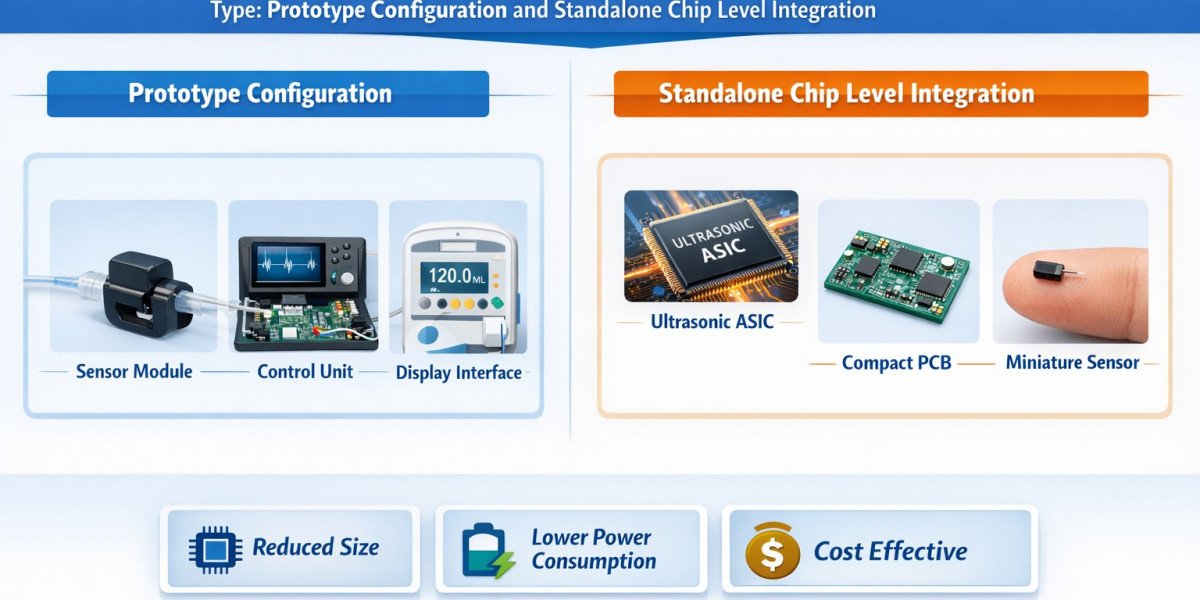
The market is segmented by type into Prototype Configuration and Standalone Chip Level Integration sensors. Prototype configuration sensors are commonly used in research, testing, and early-stage product development. They enable manufacturers and academic institutions to assess sensor performance under different conditions.
Standalone chip-level integration sensors are designed for direct embedding into medical devices. Their compact size, low power consumption, and high reliability make them ideal for mass production and widespread deployment. The growing demand for integrated and space-efficient solutions is driving the adoption of chip-level sensors across the medical device industry.
By Application
Applications of ultrasonic air in line sensors include dialysis and transfusions, heart-lung machines, blood separators, pumps for medical technology, and diagnostic systems and other devices. Dialysis and transfusion systems account for a significant share of the market due to the high frequency of use and stringent safety requirements.
The expanding use of extracorporeal devices and advanced diagnostic equipment is expected to further diversify application areas, creating new growth opportunities for sensor manufacturers.
By End-user
Based on end-user, the market is divided into hospitals and home care settings and academic and research institutes. Hospitals dominate the market due to high patient volumes and the widespread adoption of advanced medical technologies. However, the increasing use of home-based therapies and wearable medical devices is driving demand in home care settings.
Academic and research institutes contribute to market growth through innovation, product testing, and collaborative research initiatives aimed at improving sensor performance and expanding applications.
Regional Analysis and Growth Patterns
North America
North America emerged as the leading region in the ultrasonic air in line sensor market in 2022. The region’s dominance is attributed to its robust healthcare infrastructure, early adoption of advanced technologies, and substantial investment in research and development. The United States and Canada have consistently embraced sensor-based automation to maintain high standards of patient safety and quality of care.
Government funding for artificial intelligence and automation technologies indirectly supports the development of advanced medical sensors. These investments create a favorable environment for innovation and commercialization of ultrasonic air in line sensor solutions.
Europe
Europe represents a mature and steadily growing market for ultrasonic air in line sensors. Countries such as Germany, the United Kingdom, France, Italy, and Spain benefit from strong manufacturing capabilities and stringent regulatory frameworks. Emphasis on industrial automation and medical device innovation continues to drive market expansion across the region.
Asia Pacific and Emerging Regions
The Asia Pacific region is witnessing increasing adoption of ultrasonic air in line sensors due to rising healthcare expenditure, expanding hospital infrastructure, and growing awareness of patient safety. China, Japan, India, and ASEAN countries are key markets with significant growth potential.
South America, the Middle East, and Africa are gradually adopting advanced medical technologies as healthcare systems improve and government initiatives focus on enhancing medical infrastructure.
Competitive Landscape and Strategic Developments
The ultrasonic air in line sensor market features a mix of established players and specialized manufacturers. Key companies include Biosonix Ltd, Ceramtec GmbH, Introtek International, Moog, Inc., Morgan Advanced Materials, Piezo Technologies, Sensaras LLC, SONOTEC GmbH, Strain Measurement Devices, and TE Connectivity.
Competition in the market is driven by product reliability, technological innovation, and application-specific customization. Leading players are investing in research and development to improve sensor accuracy, durability, and integration capabilities. Strategic partnerships, mergers and acquisitions, and collaborations with medical device manufacturers are common strategies aimed at expanding market presence and enhancing product portfolios.
Recent Innovations and Industry Developments
In January 2024, the U.S. Patent Office published a patent application from Apple Inc. detailing a novel ultrasonic temperature sensor capable of detecting changes in environmental mediums such as blood and water. The technology’s ability to function in non-electrical mediums, including glass, highlights its potential applicability in medical sensing systems.
Such developments indicate growing interest from technology companies in the medical sensor domain, signaling future innovation and cross-industry collaboration. These advancements are expected to influence the evolution of ultrasonic air in line sensors, particularly in terms of miniaturization and multifunctionality.
Future Outlook and Market Opportunities
The future of the ultrasonic air in line sensor market appears promising, with steady growth expected through 2031. Increasing regulatory emphasis on patient safety, combined with technological advancements and rising healthcare demands, will continue to drive market expansion.
Opportunities lie in developing ultra-compact sensors, enhancing wireless connectivity, and integrating advanced analytics capabilities. Expanding applications in home care, remote monitoring, and portable medical devices will further strengthen market prospects. As healthcare systems worldwide strive for safer and more efficient care delivery, ultrasonic air in line sensors will remain a cornerstone technology.